Hugh Hefner's Engagement Ring to Crystal Harris Revealed


12/11/2012 at 07:00 PM EST


The wedding's back on – though it may be a good idea to save that gift receipt.

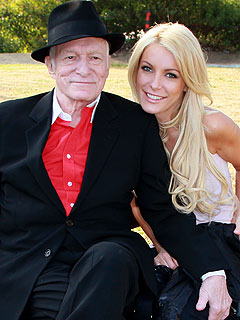
Hugh Hefner, 86, officially confirms that he is once again engaged to Crystal Harris, 26, telling his Twitter followers, "I've given Crystal Harris a ring. I love the girl."

And to prove it, Harris posted photos of the big diamond sparkler, calling it "my beautiful ring."

Neither announced a wedding date, though sources tell PEOPLE they're planning to tie the knot at the Playboy Mansion in Los Angeles on New Year's Eve.

Whether that still happens remains to be seen.

This is the plan they had in 2011 – a wedding at the mansion – except that Harris called it off just days before the nuptials were scheduled to happen in front of 300 invited guests.

Hugh Hefner's Engagement Ring to Crystal Harris Revealed| Engagements, Crystal Harris, Hugh Hefner

Hugh Hefner and Crystal Harris

David Livingston / Getty

The onetime Playmate of the Month then ripped Hef's bedroom skills, calling him a two-second man, to which Hefner replied, "I missed a bullet" by not marrying her.

A year later, Hefner's "runaway bunny" bounded back to him.

Reporting by JENNIFER GARCIA

Read More..

DA investigating Texas' troubled $3B cancer agency


AUSTIN, Texas (AP) — Turmoil surrounding an unprecedented $3 billion cancer-fighting effort in Texas worsened Tuesday when its executive director offered his resignation and the state's chief public corruption prosecutor announced an investigation into the beleaguered agency.


No specific criminal allegations are driving the latest probe into the Cancer Prevention and Research Institute of Texas, said Gregg Cox, director of the Travis County district attorney's public integrity unit. But his influential office opened a case only weeks after the embattled agency disclosed that an $11 million grant to a private company bypassed review.


That award is the latest trouble in a tumultuous year for CPRIT, which controls the nation's second-largest pot of cancer research dollars. Amid the mounting problems, the agency announced Tuesday that Executive Director Bill Gimson had submitted his letter of resignation.


"Unfortunately, I have also been placed in a situation where I feel I can no longer be effective," Gimson wrote in a letter dated Monday.


Gimson said the troubles have resulted in "wasted efforts expended in low value activities" at the agency, instead of a focused fight against cancer. Gimson offered to stay on until January, and the agency's board must still approve his request to step down.


His departure would complete a remarkable house-cleaning at CPRIT in a span of just eight months. It began in May, when Dr. Alfred Gilman resigned as chief science officer in protest over a different grant that the Nobel laureate wanted approved by a panel of scientists. He warned it would be "the bomb that destroys CPRIT."


Gilman was followed by Chief Commercialization Officer Jerry Cobbs, whose resignation in November came after an internal audit showed Cobbs included an $11 million proposal in a funding slate without a required outside review of the project's merits. The lucrative grant was given to Dallas-based Peloton Therapeutics, a biomedical startup.


Gimson chalked up Peloton's award to an honest mistake and has said that, to his knowledge, no one associated with CPRIT stood to benefit financially from the company receiving the taxpayer funds. That hasn't satisfied some members of the agency's governing board, who called last week for more assurances that no one personally profited.


Cox said he has been following the agency's problems and his office received a number of concerned phone calls. His department in Austin is charged with prosecuting crimes related to government officials; his most famous cases include winning a conviction against former U.S. House Majority Leader Tom DeLay in 2010 on money laundering charges.


"We have to gather the facts and figure what, if any, crime occurred so that (the investigation) can be focused more," Cox said.


Gimson's resignation letter was dated the same day the Texas attorney general's office also announced its investigation of the agency. Cox said his department would work cooperatively with state investigators, but he made clear the probes would be separate.


Peloton's award marks the second time this year that a lucrative taxpayer-funded grant authorized by CPRIT instigated backlash and raised questions about oversight. The first involved the $20 million grant to M.D. Anderson Cancer Center in Houston that Gilman described as a thin proposal that should have first been scrutinized by an outside panel of scientific peer-reviewers, even though none was required under the agency's rules.


Dozens of the nation's top scientists agreed. They resigned en masse from the agency's peer-review panels along with Gilman. Some accused the agency of "hucksterism" and charting a politically-driven path that was putting commercial product-development above science.


The latest shake-up at CPRIT caught Gilman's successor off-guard. Dr. Margaret Kripke, who was introduced to reporters Tuesday, acknowledged that she wasn't even sure who she would be answering to now that Gimson was stepping down. She said that although she wasn't with the agency when her predecessor announced his resignation, she was aware of the concerns and allegations.


"I don't think people would resign frivolously, so there must be some substance to those concerns," Kripke said.


Kripke also acknowledged the challenge of restocking the peer-review panels after the agency's credibility was so publicly smeared by some of the country's top scientists. She said she took the job because she felt the agency's mission and potential was too important to lose.


Only the National Institutes of Health doles out more cancer research dollars than CPRIT, which has awarded more than $700 million so far.


Gov. Rick Perry told reporters in Houston on Tuesday that he wasn't previously aware of the resignation but said Gimson's decision to step down was his own.


Joining the mounting criticism of CPRIT is the woman credited with brainstorming the idea for the agency in the first place. Cathy Bonner, who served under former Texas Gov. Ann Richards, teamed with cancer survivor Lance Armstrong in selling Texas voters in 2007 on a constitutional amendment to create an unprecedented state-run effort to finance a war on disease.


Now Bonner says politics have sullied an agency that she said was built to fund research, not subsidize private companies.


"There appears to be a cover-up going on," Bonner said.


Peloton has declined comment about its award and has referred questions to CPRIT. The agency has said the company wasn't aware that its application was never scrutinized by an outside panel, as required under agency rules.


___


Follow Paul J. Weber on Twitter: www.twitter.com/pauljweber


Read More..

Grant to aid UC Berkeley's undocumented students


UC Berkeley announced a $1-million grant Tuesday to boost financial aid for undocumented students, which is thought to be the largest gift of its kind in the nation.

The donation from the Evelyn and Walter Haas Jr. Fund will supplement state aid for undocumented students that is scheduled to roll out over the next two semesters in a policy change authorized by the California Dream Act. Undocumented students will be eligible for state aid but not for federal grants or loans, and the donation — along with other private funds — will help fill in the gaps, officials said.


Starting next fall, the donation is expected to aid about 100 students a year with annual grants of $4,000 to $6,000 until the funds run out, officials said.


UC Berkeley Chancellor Robert J. Birgeneau said Tuesday that the Haas Fund gift grew out of a dinner he hosted last year to which he invited some undocumented students and some past UC donors, including Haas family members. The students talked about their immigration history and how they came to enroll at UC, deeply impressing the guests, he recalled.


"The individual stories of these students are so compelling," he said. "They are heroic. They encounter … challenges that very few of our students have to deal with." The Haas Fund later made the donation without a direct solicitation, he said.


Birgeneau said one of the biggest challenges for undocumented college students is that they cannot legally work to earn extra money for living expenses or books, even if they receive significant aid for tuition.


The extended Haas family, whose fortune comes from Levi Strauss Co., which makes jeans, has been generous to UC and San Francisco-area charities. Haas Fund President Ira Hirschfield called the future scholarship recipients "motivated, hardworking and inspiring."


An estimated 200 undocumented undergraduates attend UC Berkeley, and as many as 5,000 attend other California colleges. California is one of a dozen states allowing illegal immigrants to pay in-state tuition.


An earlier $300,000 gift from Elise Haas, granddaughter of the fund's founders, provides support services, such as academic and legal advice, a textbook lending library and mental health resources, for undocumented students at UC Berkeley.


Uriel Rivera, an undocumented student whose family emigrated from Mexico when he was 15, plans to return to UC Berkeley next semester after taking time off because he couldn't make ends meet. He saved money working at his family's convenience store in Los Angeles.


The new state aid, and the possibility of the Haas money, will be a great relief, he said. "I'm no longer going to be worried in school about what I'm going to eat, how I'm going to afford a place to live next semester, owing fines because I can't pay for tuition," said Rivera, 23, an ethnic studies and public policy major.


larry.gordon@latimes.com


cindy.chang@latimes.com


Read More..

World Briefing | Asia: Chinese Leader Offers Policy Hints


The state news media confirmed Monday that Xi Jinping, the new Communist Party chief, visited Guangdong Province over the weekend, a trip first reported by Hong Kong news organizations. Mr. Xi chose Guangdong and the special economic zone of Shenzhen for his first tour outside of Beijing as party chief, signaling that he might favor more market-oriented economic policies. Xinhua, the state news agency, reported Monday that Mr. Xi met with business executives in Guangzhou and talked about tax reform, support for exports, aid for small businesses and land use. “We need both a firm confidence in victory and a stronger sense of peril,” he said, and added that officials should carry out “deeper reform,” improve the mechanisms of the market economic system and strengthen the “rule of law.”


Read More..

Hayden Panettiere Splits with Scotty McKnight


12/10/2012 at 07:50 PM EST


Hayden Panettiere and Scotty McKnight


Splash News Online


Is there a tear in her beer?

Nashville star Hayden Panettiere has broken up with her boyfriend of more than a year, New York Jets wide receiver Scotty McKnight, a source confirms to PEOPLE.

But the split doesn't appear to be the stuff of a sad country song. The actress, 23, is still friends with McKnight, 24, and one source tells TMZ that their pals wouldn't be surprised if they got back together.

This is Panettiere's second go at a relationship with an athlete. Before dating McKnight she was with Ukrainian boxer Wladimir Klitschko for about two years.
Julie Jordan

Read More..

L.A. Archdiocese personnel files could be released next month


After five years of legal wrangling, confidential personnel files of at least 69 priests accused of sexually abusing children in the Los Angeles Archdiocese could be ordered released as early as January, a Los Angeles County Superior Court judge said Monday.


Judge Emilie H. Elias set a hearing for Jan. 7 to hear objections to the release of what a church attorney said were five or six banker's boxes of files relating to the archdiocese's handling of child molestation claims, which could include internal memos, Vatican correspondence and psychiatric reports.


The public release of the files was agreed to as part of a record $660-million settlement reached in 2007 between the archdiocese and 562 people who alleged that they were molested as children by clergy members. The process, overseen by a retired judge, was beset by delays and faced objections from an attorney representing at least 30 of the priests, who contends that his clients' constitutional rights to privacy are at stake.


The retired judge, Dickran Tevrizian, also ordered that all names of church leaders, including Cardinal Roger M. Mahony, who retired as archbishop last year, be blacked out in the files, saying the information should not be used to embarrass the archdiocese. Attorneys for The Times on Friday filed a motion opposing the redaction of church officials' names, contending that the public has a right to know who in the hierarchy knew of molestation allegations and what they did about it.


"Without this information," lawyers for the newspaper wrote, " the public will not be able to assess the extent of institutional or individual knowledge of the abuse."


At a hearing Monday, an attorney representing abuse victims accused the church of going beyond the judge's rulings in their redactions and withholding of files. "The archdiocese is trying to drive a truck through the exceptions Judge Tevrizian is setting," attorney Ray Boucher told Elias.


Church attorney J. Michael Hennigan said his staff complied with Tevrizian's order "literally and expansively." He said that he wanted a "very short fuse" on the process of individual priests' objections to the files and that the archdiocese is eager to complete the document release, possibly by mid-January.


Elias ordered church attorneys to submit to her for review both the redacted and unredacted versions of the documents.


Donald Steier, an attorney for the priests, said he would file legal papers by late December objecting to the files being made public. At the hearing, Steier accused archdiocese officials of failing to defend the priests' rights.


"They have a duty to help protect those files, and they've already breached that," he said.


victoria.kim@latimes.com


harriet.ryan@latimes.com


ashley.powers@latimes.com


Read More..

Sunni Muslim and Alawite Militias Clash in Lebanon


Omar Ibrahim/Reuters


Lebanese gunmen fired in Tripoli as bodies arrived from Syria.


TRIPOLI, Lebanon — Clashes between Sunni Muslim and Alawite militias have killed at least 17 people here recently in perhaps the worst spillover of violence from the civil war in neighboring Syria.


Tripoli, which is Lebanon’s second-largest city and is close to the northern border with Syria, has long been the scene of conflict between Sunni Muslims in the city’s Bab al-Tabbaneh neighborhood and Alawites in the hilltop section of Jabal Mohsen, with each group maintaining militias.


But during the 21-month conflict in Syria, the web of religious and family ties and fault lines between the two countries has created new strains, especially in Tripoli. Lebanese Sunnis have increasingly supported and even joined the Sunni-led uprising against President Bashar al-Assad of Syria, who is Alawite and whose sect dominates the government. Refugees from both sects have flowed into the city.


As some Tripoli residents begin to see themselves as part of the Syrian conflict — to the dismay of the Lebanese government, which fears being dragged into the war — the intensity and frequency of fighting has increased dramatically, with clashes sometimes ignited by events in Syria. Scores have been killed here this year.


The latest conflict began after a number of Sunni fighters from northern Lebanon were killed in an ambush by pro-government forces as they tried to enter Syria to join opposition fighters. Sunnis in Tripoli, angry over videos that purported to show the men’s bodies being stabbed and kicked, attacked Alawites, starting days of clashes between militias wielding rifles and rocket-propelled grenades. Lebanese news media put the death toll at 17.


Lebanon is divided over Syria, with the parliamentary opposition bloc fiercely opposed to Mr. Assad, and as the Syrian conflict has become more sectarian, so has the Lebanese debate. Many Shiites and Alawites support Mr. Assad and fear that Syria’s Sunni majority will take revenge against minorities, while many Lebanese Sunnis, emboldened by the uprising, have struck an aggressive posture toward a government they see as dominated by the Syria-backed Islamist party Hezbollah and weakened by Mr. Assad’s troubles.


Sunni fighters from northern Lebanon, including the Bab al-Tabbaneh neighborhood, now routinely cross into Syria to fight. Many link up with Islamist factions like Jabhet al-Nusra, a group that the United States is considering declaring a terrorist organization.


Militia leaders in Bab al-Tabbaneh say they frown on their men going to Syria because it leaves them short-handed for any conflict at home. But it is hard to stop fighters who feel a personal connection to the civil war.


Some of the young men from Bab al-Tabbaneh showed up as corpses in videos circulated on cellphones by rebel supporters. One video showed bodies being repeatedly stabbed with knives. In another, men shouted insults as they kicked and stomped on corpses’ heads.


A Sunni militia commander in Bab al-Tabbaneh who goes by the name Abu Bera identified one of the men as his friend Hussein Sorour, a 24-year-old baker and fighter.


Even during a lull in fighting on Saturday, snipers atop the hill of Jabal Mohsen made streets in Bab al-Tabbaneh unsafe. People traversed the neighborhood by passing through a maze of holes knocked out of walls and crossing alleys with huge tarps strung up to obstruct the view of snipers. One young boy walked down an alley carrying a Kalashnikov assault rifle. He said he was 11.


There is a fear that the clashes could spread to other parts of Tripoli. Violence has touched the affluent and usually quiet city center. Rockets and mortars have hit the area more than a dozen times over the past week, said Racha el-Halabi, 19, a university student and journalist.


“It’s the first time ever,” she said. “Everyone is worried.”


Read More..

Tim McGraw and Faith Hill Kick Off Special Series of Las Vegas Shows


12/09/2012 at 05:00 PM EST


Tim McGraw and Faith Hill


Denise Truscello/WireImage


Tim McGraw and Faith Hill looked at each other, their hands on each others knees and shared a passionate kiss just after midnight Sunday morning.

The moment was a long time coming – it capped off their first weekend as a Las Vegas headlining act.

Earlier in the 90 minute show, McGraw told the crowd at the Venetian that he and his wife were going to "have fun tonight" and it genuinely seemed like they did, singing with each other for several songs while still letting the other perform their solo hits. Though the show – called the Soul2Soul series – is technically not the same "residency" show Las Vegas is known for, the couple will perform for 10 weekends through April.

At a press conference several months ago, McGraw and Hill promised a "personal" show, and they delivered in a big way. In fact, it got very personal as McGraw complimented his wife on her flowing black dress, saying, "It's gonna look good on the floor later."

The duo also took a moment to sit down and speak with the crowd. Though they didn't field any questions, they spoke about the most common questions they get asked. "We always get asked what was the music we heard first, who influenced us," Hill said.

Rather than answer it, the duo then sing a few of their main influences – Hill sang George Strait; McGraw sang The Eagles.

"I love doing other people's music, better than my own," McGraw joked.

With few bells and whistles, the show puts the focus squarely on it's two superstars, and considering the rousing ovations McGraw and Hill received Saturday, that's perfectly fine with their fans.

Read More..

Smokers celebrate as Wash. legalizes marijuana


SEATTLE (AP) — The crowds of happy people lighting joints under Seattle's Space Needle early Thursday morning with nary a police officer in sight bespoke the new reality: Marijuana is legal under Washington state law.


Hundreds gathered at Seattle Center for a New Year's Eve-style countdown to 12 a.m., when the legalization measure passed by voters last month took effect. When the clock struck, they cheered and sparked up in unison.


A few dozen people gathered on a sidewalk outside the north Seattle headquarters of the annual Hempfest celebration and did the same, offering joints to reporters and blowing smoke into television news cameras.


"I feel like a kid in a candy store!" shouted Hempfest volunteer Darby Hageman. "It's all becoming real now!"


Washington and Colorado became the first states to vote to decriminalize and regulate the possession of an ounce or less of marijuana by adults over 21. Both measures call for setting up state licensing schemes for pot growers, processors and retail stores. Colorado's law is set to take effect by Jan. 5.


Technically, Washington's new marijuana law still forbids smoking pot in public, which remains punishable by a fine, like drinking in public. But pot fans wanted a party, and Seattle police weren't about to write them any tickets.


In another sweeping change for Washington, Gov. Chris Gregoire on Wednesday signed into law a measure that legalizes same-sex marriage. The state joins several others that allow gay and lesbian couples to wed.


The mood was festive in Seattle as dozens of gay and lesbian couples got in line to pick up marriage licenses at the King County auditor's office early Thursday.


King County and Thurston County announced they would open their auditors' offices shortly after midnight Wednesday to accommodate those who wanted to be among the first to get their licenses.


Kelly Middleton and her partner Amanda Dollente got in line at 4 p.m. Wednesday.


Hours later, as the line grew, volunteers distributed roses and a group of men and women serenaded the waiting line to the tune of "Chapel of Love."


Because the state has a three-day waiting period, the earliest that weddings can take place is Sunday.


In dealing with marijuana, the Seattle Police Department told its 1,300 officers on Wednesday, just before legalization took hold, that until further notice they shall not issue citations for public marijuana use.


Officers will be advising people not to smoke in public, police spokesman Jonah Spangenthal-Lee wrote on the SPD Blotter. "The police department believes that, under state law, you may responsibly get baked, order some pizzas and enjoy a 'Lord of the Rings' marathon in the privacy of your own home, if you want to."


He offered a catchy new directive referring to the film "The Big Lebowski," popular with many marijuana fans: "The Dude abides, and says 'take it inside!'"


"This is a big day because all our lives we've been living under the iron curtain of prohibition," said Hempfest director Vivian McPeak. "The whole world sees that prohibition just took a body blow."


Washington's new law decriminalizes possession of up to an ounce for those over 21, but for now selling marijuana remains illegal. I-502 gives the state a year to come up with a system of state-licensed growers, processors and retail stores, with the marijuana taxed 25 percent at each stage. Analysts have estimated that a legal pot market could bring Washington hundreds of millions of dollars a year in new tax revenue for schools, health care and basic government functions.


But marijuana remains illegal under federal law. That means federal agents can still arrest people for it, and it's banned from federal properties, including military bases and national parks.


The Justice Department has not said whether it will sue to try to block the regulatory schemes in Washington and Colorado from taking effect.


"The department's responsibility to enforce the Controlled Substances Act remains unchanged," said a statement issued Wednesday by the Seattle U.S. attorney's office. "Neither states nor the executive branch can nullify a statute passed by Congress."


The legal question is whether the establishment of a regulated marijuana market would "frustrate the purpose" of the federal pot prohibition, and many constitutional law scholars say it very likely would.


That leaves the political question of whether the administration wants to try to block the regulatory system, even though it would remain legal to possess up to an ounce of marijuana.


Alison Holcomb is the drug policy director of the American Civil Liberties Union of Washington and served as the campaign manager for New Approach Washington, which led the legalization drive. She said the voters clearly showed they're done with marijuana prohibition.


"New Approach Washington sponsors and the ACLU look forward to working with state and federal officials and to ensure the law is fully and fairly implemented," she said.


___


Johnson can be reached at https://twitter.com/GeneAPseattle


Read More..

Rise in renewable energy will require more use of fossil fuels


The Delta Energy Center, a power plant about an hour outside San Francisco, was roaring at nearly full bore one day last month, its four gas and steam turbines churning out 880 megawatts of electricity to the California grid.


On the horizon, across an industrial shipping channel on the Sacramento-San Joaquin River Delta, scores of wind turbines stood dead still. The air was too calm to turn their blades — or many others across the state that day. Wind provided just 33 megawatts of power statewide in the midafternoon, less than 1% of the potential from wind farms capable of producing 4,000 megawatts of electricity.


As is true on many days in California when multibillion-dollar investments in wind and solar energy plants are thwarted by the weather, the void was filled by gas-fired plants like the Delta Energy Center.


One of the hidden costs of solar and wind power — and a problem the state is not yet prepared to meet — is that wind and solar energy must be backed up by other sources, typically gas-fired generators. As more solar and wind energy generators come online, fulfilling a legal mandate to produce one-third of California's electricity by 2020, the demand will rise for more backup power from fossil fuel plants.


"The public hears solar is free, wind is free," said Mitchell Weinberg, director of strategic development for Calpine Corp., which owns Delta Energy Center. "But it is a lot more complicated than that."


Wind and solar energy are called intermittent sources, because the power they produce can suddenly disappear when a cloud bank moves across the Mojave Desert or wind stops blowing through the Tehachapi Mountains. In just half an hour, a thousand megawatts of electricity — the output of a nuclear reactor — can disappear and threaten stability of the grid.


To avoid that calamity, fossil fuel plants have to be ready to generate electricity in mere seconds. That requires turbines to be hot and spinning, but not producing much electricity until complex data networks detect a sudden drop in the output of renewables. Then, computerized switches are thrown and the turbines roar to life, delivering power just in time to avoid potential blackouts.


The state's electricity system can handle the fluctuations from existing renewable output, but by 2020 vast wind and solar complexes will sprawl across the state, and the problem will become more severe.


Just how much added capacity will be needed from traditional sources is the subject of heated debate by utility officials, government regulators and policy experts. The concerns are expected to come to a head next year when the state must adopt a 10-year plan for its energy needs.


"This issue is someplace between a significant concern and a major problem," said electricity system expert Severin Borenstein, a professor at UC Berkeley's Haas School of Business. "There is definitely going to be a need for more reserves."


Borenstein said state legislators and the governor did not consider all of the details, such as unleashing this new demand for fossil fuel generators, when they set the 33% mandate for renewable energy. The state now gets 20% of its power from renewables, in part from older hydro and geothermal energy. Gov. Jerry Brown has advocated upping the goal to 40%.


The cost to consumers in the years ahead could be in the billions of dollars, according to industry experts. California's electricity prices are already among the highest in the nation and are projected to rise sharply in coming years. At the moment, the need for reserve power isn't considered a cost of renewable power, though consumers have to bear its costs as well.


The California Independent System Operator, the nonprofit company that runs the grid, estimates that by 2020 the state will need to double its reserve capacity. California now maintains a margin of 7% to 8% above projected daily demand, in case a nuclear power plant goes offline or outages occur. But when 33% of the state's power comes from renewables, that margin will have to rise to 15%, said Stephen Berberich, the firm's chief executive.


Nobody knows whether Berberich's estimate is right or how much the added capacity will cost. The California Energy Commission, which has responsibility for licensing new power plants and forecasting future power demand, said it doesn't have the analytical tools necessary to know how much reserve power will be needed.


"It is frankly in the development stage," said Mike Jaske, the commission's senior policy analyst for electricity supply.


The independent system operator is warning that by 2017 the state will be short by about 3,100 megawatts of flexible power that it can dedicate to meeting reserve needs — about what three nuclear reactors produce. The company is pushing the state Public Utility Commission to require that capacity. The commission has been noncommittal so far.


Solar and wind advocates reject those concerns. They say renewables can provide their own reserve cushion because solar and wind generators will be spread across vast areas of the state. If wind power is down in one region, it might be up in another. If wind power is down statewide, desert sunshine might boost solar.


On the day last month when wind energy provided just 33 megawatts of power statewide, a brilliant sun spiked solar plant output.


The independent system operator "likes to show these frightening graphs for shock value," said Nancy Rader, executive director of the California Wind Energy Assn.


Edward Randolph, director of the Public Utility Commission's energy division, said the independent system operator understandably wants more reserves because its primary focus is on the reliability of the system. The PUC is focused on cost. If there is an immediate problem with reserves, the PUC can order utilities to make more available. And in three to five years, batteries, flywheels or other new technology can provide storage that would make reserves much less necessary, he said.


Read More..